Fisher 2 Channel Am Fm Stereo Receiver Model No 14392551600 Review

 | |
| Type | Corporation |
|---|---|
| Industry | Electronics |
| Founded | 1945 in New York City |
| Defunct | 2000 in New York City |
| Fate | Acquired by Sanyo Electrical |
| Products | Audio-visual and communication equipment, Hullo-fi equipment, Home appliances |
| Website | www |
Fisher Electronics was an American company specialising in the field of hello-fi electronics. The company and the name was bought by Japanese electronics conglomerate Sanyo in 1975.
History [edit]
Fisher Electronics was an American audio equipment manufacturer founded in 1945 by Avery Fisher in New York City, New York. Originally named the Fisher Radio Corporation, the company is considered a pioneer in high fidelity audio equipment. Fisher initially adult, manufactured and marketed loftier-functioning audio products under the merchandise name "The Fisher".[1]
In February 1969, Emerson Electric announced plans to purchase Fisher Radio.[ii] [3] To buy Fisher, Emerson initially agreed to exchange 736,000 shares in a transaction worth approximately $75 million.[4] Emerson later agreed to pay approximately $37 million in stock to larn Fisher.[five] The buy was completed afterward that year.[6] Emerson after sold Fisher to Sanyo Electric of Japan in 1975. In 2000, Fisher's entire product lineup was re-branded as Sanyo. Upon the acquisition of Sanyo past Panasonic in 2011,[7] Sanyo's product lineup was, in plough, re-branded as Panasonic.[viii] Avery Fisher remained as a consultant for Emerson and Sanyo.
Fisher is mostly known to exist the first company to introduce separate audio components. Originally, hi-fi systems were integrated all into one chassis.
The Fisher [edit]
The Fisher was the brand proper name for high-finish, high quality hi-fi electronic equipment manufactured in New York past The Fisher Radio Corp. during the "gilt historic period" of the vacuum tube, which was named after the visitor founder, Avery Fisher.[nine] [10] [11]
During this flow, similar brands were H.H. Scott, Marantz, Harman Kardon, and McIntosh. Some of the early 1960s models were also available as kits. Fisher tube equipment is considered quite collectible today.
Fisher'southward get-go receiver was the model 500, a mono AM/FM receiver using two EL37 output tubes. Information technology had a brass-plated face up console and an optional mahogany or "blonde" wooden instance. This early mono receiver should non be confused with the later stereo tube receiver models, the 500B and 500C.[ix] These afterwards receivers made in the early 1960s were stereo using push-pull 7591 output tubes. They were also sold with optional wood cabinets and had aluminum faceplates instead of the brass on the earlier 500 receiver.
Well-known models include (but are not limited to):
- FM-thousand/FMR-1 Broadcast Monitor Tuner, considered one of the best tube tuners, collectible[12]
- FM-200-B Tuner - VERY similar to FM-one thousand above but for home use
- FM-100-B Tuner
- 800 Series Receiver A,B,C, AM/FM, 7591A outputs
- 500 Series Receiver A,B,C, FM only, 7591A outputs
- 400 Series Receiver, FM just, 7868 outputs, like to model 500, but with fewer features
- Ten-1000 Serial Integrated Amplifier
- X-200 Series Integrated Amplifier
- 10-100 Series Integrated Amplifier
The Fisher was as well used on Fisher'southward early US fabricated solid-state equipment, such as the model 210 receiver.
Fisher FM tuners and receivers often used like designs and components thus allowing parts to exist swapped between various models. A practiced instance is the FM stereo multiplex decoder module.[9]
Fisher was the first to innovate stereo receivers with four channels. These innovations were brief and occurred in the mid-1970s which some[ who? ] consider The Second Gold Age of High Allegiance. Like many new concepts of the fourth dimension such as Beta Format and VHS, there were 2 competing four channel formats. One was CD-four and the other was SQ. Neither was successful as the purist found separation from highly defined loudspeakers and low distortion receivers and amplifiers.
At the time the concept of a sub-woofer was in its infancy. Now, it is mutual to run across 5+1 systems which had their heritage in the "confrontation" of four-channel and stereo loftier allegiance coupled with a sub woofer.
Other consumer products [edit]
Under Sanyo buying, Fisher besides commercialized a range of consumer products[13] including
- tv sets,HiFi VHS recorders,projectors and DVD players, digicams and surveillance equipment
- audio systems and dictation machines, mobile devices and phones
- household machinery and air conditioners
In particular, the air conditioning concern of Sanyo and Fisher brands was unified in 2000 under the Sanyo Electric Air Workout Co. Ltd. scheme,[fourteen] to end up eventually in 2011 with the buyout from Panasonic.
Photograph gallery [edit]
-

Adequately rare Fisher Allegro Model X19 Tube 20 watt stereo amplifier and matching FM Multiplex Tuner, circa 1962
-
-

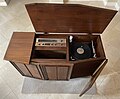
Fisher Custom Electra Console - 1967 - Model E-492-W - 21-R Solid State Chassis - 45 Watts Original Price: $599.50 - Made in U.Southward.A. - Plow Table: Dual 1010 (W.Federal republic of germany). Still functioning in 2021.
-

Fisher Allegro A19 Tube Tuner and Model X19 Amplifier as removed from "portable console"
-

Circa 1962 Fisher Model 800B AM/FM Tube Stereo Receiver 32 watts per channel - $429.00 list price
-

Fisher 800B Tube Stereo Receiver
-

Fisher often used the Tuning Center or "Stereo Beam" and "Stereo Beacon" as shown on the Model 800B
-

Typical Fisher marketing brochure from this menses - circa 1964
-
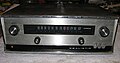
Extremely rare Model 214 FM Multiplex Tube Tuner made by Fisher and sold with Realistic badging through RadioShack stores circa 1962
-

Fisher MC-3010 Integrated Component System (Receiver and 8-Rails Player/Recorder Combo circa 1975)
-

A Fisher Electronics tape player and tape deck, without speakers
-

Fisher PC-367WS goggle box set up, manufactured 1987
References [edit]
- ^ Fisher, Avery. "Avery Fisher". Created past North. Brewer 2008-08-thirteen. IEEE Global History Network. Retrieved 2011-03-31 .
- ^ "Emerson Buys Fisher Radio". The Miami News. Feb five, 1969. Retrieved March 9, 2019.
- ^ "Emerson-Fisher Radio Merger Approved". Democrat and Chronicle. February 6, 1969. Retrieved March ix, 2019 – via Newspapers.com.
- ^ "News". Detroit Complimentary Press. Feb 22, 1969. Retrieved March nine, 2019 – via Newspapers.com.
- ^ "Emerson To Pay $37 Million For Radio Firm". The Pittsburgh Press. February 25, 1969. Retrieved March 9, 2019 – via Newspapers.com.
- ^ "Emerson Volition Stress New Product Search". St. Louis Post-Acceleration. January 11, 1970. Retrieved March 9, 2019 – via Newspapers.com.
- ^ "Panasonic Announces that it Makes Sanyo its Wholly-endemic Subsidiary through Share Exchange" (PDF). December 21, 2010. Archived from the original (PDF) on September 10, 2016. Retrieved March 24, 2014.
- ^ Milligan, Paul (November 29, 2011). "Sanyo name to terminate by April 1, 2012, Panasonic tells partners". AV Interactive.
- ^ a b c Breuninger, Peter (June 2005). "Fisher 500-C vintage stereo receiver". Stereophile Magazine. Retrieved 16 July 2010.
- ^ Ad for The Fisher Statesman. Life Magazine. 24 February 1967. p. R1. Retrieved xvi July 2010.
- ^ Hoffmann, Frank Westward.; Ferstler, Howard (2004). Encyclopedia of Recorded Sound, Book 1. Routledge. ISBN978-0-415-93835-8.
- ^ Salvatore, Arthur. (December 2009). Vintage Components: Recommended Components. loftier-endaudio.com; High-Cease Audio Ltd. Retrieved xvi July 2010.
- ^ Harris, Michael R. (November 22, 2004). "SANYO FISHER LOWERS PRICE OF FVD-C1 CAMERACORDER TO $699". SANYO Fisher Company. Retrieved August 16, 2016.
- ^ Sprague, Gary (July twenty, 2015). "Sanyo Heat Pumps and Air Conditioning". furnacecompare.com. Retrieved August xvi, 2016.
External links [edit]
- Official website
Source: https://en.wikipedia.org/wiki/Fisher_Electronics
0 Response to "Fisher 2 Channel Am Fm Stereo Receiver Model No 14392551600 Review"
Post a Comment