what caused life to go from single cell to multi cell
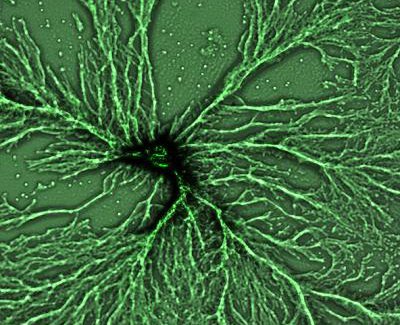
Cells of Dictyostelium purpureum, a mutual soil microbe, streaming to form a multicellular fruiting torso. Credit: Natasha Mehdiabadi/Rice University
Scientists are discovering means in which single cells might have evolved traits that entrenched them into group behavior, paving the fashion for multicellular life. These discoveries could shed calorie-free on how complex extraterrestrial life might evolve on conflicting worlds.
Researchers detailed these findings in the October 24, 2016 upshot of the journal Scientific discipline.
The get-go known single-celled organisms appeared on Earth about three.v billion years agone, roughly a billion years after Earth formed. More complex forms of life took longer to evolve, with the first multicellular animals non actualization until about 600 million years ago.
The development of multicellular life from simpler, unicellular microbes was a pivotal moment in the history of biology on World and has drastically reshaped the planet's ecology. Withal, one mystery about multicellular organisms is why cells did not return back to single-celled life.
"Unicellularity is clearly successful — unicellular organisms are much more arable than multicellular organisms, and have been around for at least an additional 2 billion years," said lead study writer Eric Libby, a mathematical biologist at the Santa Fe Establish in New Mexico. "So what is the advantage to beingness multicellular and staying that mode?"
The answer to this question is normally cooperation, as cells benefitted more from working together than they would from living alone. Nonetheless, in scenarios of cooperation, in that location are constantly tempting opportunities "for cells to shirk their duties — that is, crook," Libby said.
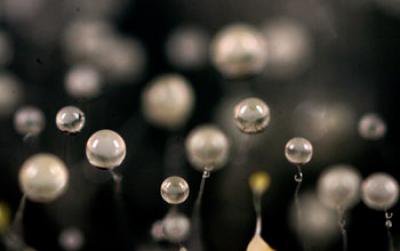
When social amoeba Dictyostelium discoideum starves, it forms a multicellular body. Credit: Scott Solomon
"As an case, consider an ant colony where just the queen is laying eggs and the workers, who cannot reproduce, must cede themselves for the colony," Libby said. "What prevents the ant worker from leaving the colony and forming a new colony? Well, obviously the ant worker cannot reproduce, so it cannot start its ain colony. Only if it got a mutation that enabled information technology to do that, then this would be a real problem for the colony. This kind of struggle is prevalent in the evolution of multicellularity considering the showtime multicellular organisms were only a mutation abroad from being strictly unicellular."
Experiments have shown that a grouping of microbes that secretes useful molecules that all members of the group can benefit from can grow faster than groups that do non. But inside that grouping, freeloaders that practise not expend resources or energy to secrete these molecules grow fastest of all. Another example of cells that abound in a fashion that harms other members of their groups are cancer cells, which are a potential problem for all multicellular organisms.
Indeed, many primitive multicellular organisms probably experienced both unicellular and multicellular states, providing opportunities to forego a group lifestyle. For example, the bacterium Pseudomonas fluorescens rapidly evolves to generate multicellular mats on surfaces to proceeds better access to oxygen. Notwithstanding, in one case a mat has formed, unicellular cheats have an incentive to not produce the glue responsible for mat formation, ultimately leading to the mat's devastation.
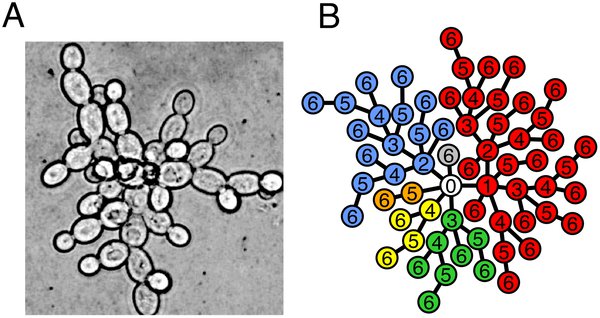
Groups of yeast cells. If key cells dice a programmed death, these groups can separate. Credit: E. Libby et al., PLOS Computational Biology
To solve the mystery of how multicellular life persisted, scientists are suggesting what they phone call "ratcheting mechanisms." Ratchets are devices that permit motility in but one direction. By analogy, ratcheting mechanisms are traits that provide benefits in a group context only are detrimental to loners, ultimately preventing a reversion to a single-celled state, said Libby and study co-author William Ratcliff at the Georgia Institute of Applied science in Atlanta.
In general, the more a trait makes cells in a grouping mutually reliant, the more it serves as a ratchet. For instance, groups of cells may divide labor then that some cells grow ane vital molecule while other cells grow a dissimilar essential compound, so these cells do better together than autonomously, an idea supported by recent experiments with bacteria.
Ratcheting tin likewise explain the symbiosis between ancient microbes that led to symbionts living within cells, such as the mitochondria and chloroplasts that respectively help their hosts brand use of oxygen and sunlight. The single-celled organisms known as Paramecia do poorly when experimentally derived of photosynthetic symbionts, and in plough symbionts typically lose genes that are required for life outside their hosts.
These ratcheting mechanisms tin can pb to seemingly nonsensical results. For instance, apoptosis, or programmed prison cell death, is a process by which a cell essentially undergoes suicide. Even so, experiments show that higher rates of apoptosis can really have benefits. In big clusters of yeast cells, apoptotic cells human action like weak links whose death allows small clumps of yeast cells to interruption costless and go on to spread elsewhere where they might have more room and nutrients to grow.
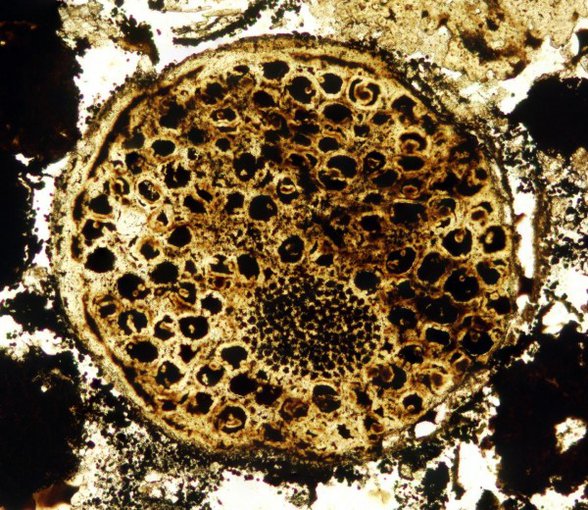
A fossil of a 600 meg-year-old multicellular organism displays unexpected evidence of complication. Credit: Virginia Tech
"This advantage does not work for single cells, which meant that whatsoever prison cell that abandoned the group would suffer a disadvantage," Libby said. "This work shows that a cell living in a group can experience a fundamentally dissimilar surroundings than a jail cell living on its own. The environment can be so different that traits disastrous for a lonely organism, like increased rates of expiry, tin go advantageous for cells in a grouping."
When it comes to what these findings mean in the search for conflicting life, Libby said this research suggests that extraterrestrial behavior might appear odd until 1 better understands that an organism may be a member of a group.
"Organisms in communities can adopt behaviors that would appear baroque or counterintuitive without proper consideration of their communal context," Libby said. "It is essentially a reminder that a puzzle piece is a puzzle until you know how it fits into a larger context."
Libby and his colleagues programme to identify other ratcheting mechanisms.
"We also have some experiments in the works to calculate the stability provided by some possible ratcheting traits," Libby said.
Source: https://astrobiology.nasa.gov/news/how-did-multicellular-life-evolve/
0 Response to "what caused life to go from single cell to multi cell"
Post a Comment